View in other NatureServe Network Field Guides
NatureServe
Montana
Utah
Wyoming
Idaho
Wisconsin
British Columbia
South Carolina
Yukon
California
New York
Western Porcupine Grass - Stipa curtiseta
Other Names:
Hesperostipa curtiseta
Native Species
Global Rank:
G5
State Rank:
SU
(see State Rank Reason below)
C-value:
Agency Status
USFWS:
USFS:
BLM:
State Rank Reason (see State Rank above)
Hesperostipa curtiseta grows in prairies and grasslands in the northern portions of the central plains and intermontane grasslands in Canada and western USA (Barkworth in Flora of North America (FNA) 2007). In the Flora of North America (2007), Barkworth distinguished Hesperostipa curtiseta as different from Hesperostipa comata. In the Family Poaceae treatment published in the Manual of Montana Vascular Plants (lesica et al. 2022), Lavin retains the name of Stipa curtiseta and found great variation in the density, cover, and degree of whiteness of the lemma hairs, making specimens of Hesperostipa curtiseta and Hesperostipa comata indistinguishable. Over the decades, both names have been inconistently used and applied by professionals in the field, in agency databases, and to herbarium specimens. In addition, similarities among Hesperostipa curtiseta, H. comata, and H. spartea have led to misidentifications in the field and with herbarium specimens. A thorough statewide review that examines the morphology, geography, and ecology of all herbarium specimens along with additional field collections is necessary to determine the distribution, population size, and conservation status of Hesperostipa curtiseta. Therefore, the conservation status of Hesperostipa curtiseta is unrankable (SU) in Montana.
General Description
Cespitose perennials 30-65 cm tall. Culms sometimes hairy at nodes. Leaf sheaths glabrous; ligules of upper leaves 1-2.5 mm long and pointed, those of lower leaves 0.2-0.8 mm wide and truncate; blades 8-26 cm long, 0.6-2.5 mm wide (usually involute at maturity). Panicle 6-24 cm long, contrated. Glumes subequal, 1.4-2.6 cm long, acuminate or awn-ponted, mostly 5-to 7-nerved; lemma 10.5-14 mm long, indistintly 5-nerved, strongly hairy on callus and lower part and the upper margins, rarely the pubescence more general, a small crown of hairs at base of awn; awns 5-10.5 cm long, twice geniculate (bent), the lower portion tightly twisted, the upper part relatively straight; palea prominent but enclosed by lemma; anthers 0.1-0.5 mm long (flowers cleistogamous) (adapted from: Sutherland, 1986, Flora of the Great Plains).
Treated as a synonym of Stipa comata by Lavin (2012).
Species Range
Montana Range
Range Descriptions
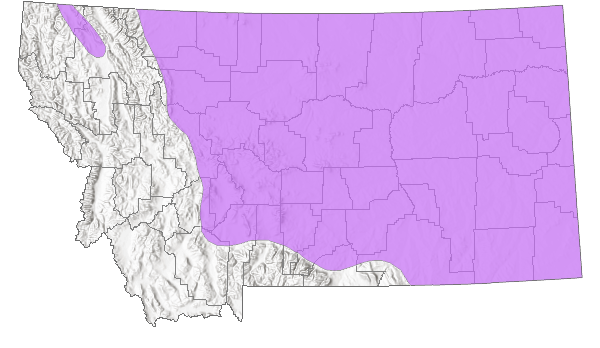
 Native
Range Comments
Canada south to MT, ND, and northeast WY (Barkworth 2007 in Fl. N. Amer. Vol. 24).
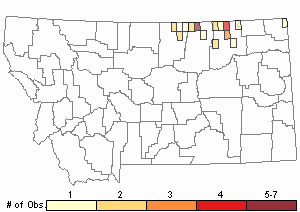
Observations in Montana Natural Heritage Program Database
Number of Observations: 49
(Click on the following maps and charts to see full sized version)
Map Help and Descriptions
Relative Density
Recency
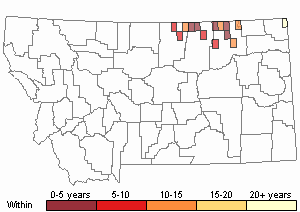

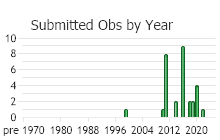
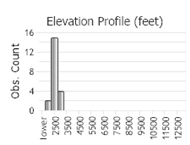 (Observations spanning multiple months or years are excluded from time charts)
Habitat
Light to clay loam in prairies and northern intermontane grasslands (Barkworth 2007 in Fl. N. Amer. Vol. 24).
National Vegetation Classification System Groups Associated with this Species
Grassland
Lowland - Prairie Grassland
Stewardship Responsibility
References
- Additional ReferencesLegend:
 View Online Publication
Do you know of a citation we're missing?- Lesica, P., M.T. Lavin, and P.F. Stickney. 2012. Manual of Montana Vascular Plants. Fort Worth, TX: BRIT Press. viii + 771 p.
- Lesica, P., M.T. Lavin, and P.F. Stickney. 2022. Manual of Montana Vascular Plants, Second Edition. Fort Worth, TX: BRIT Press. viii + 779 p.
- Web Search Engines for Articles on "Western Porcupine Grass"