View in other NatureServe Network Field Guides
NatureServe
Montana
Utah
Wyoming
Idaho
Wisconsin
British Columbia
South Carolina
Yukon
California
New York
Small Tofieldia - Tofieldia pusilla
State Rank Reason (see State Rank above)
DRAFT: Requesting feedback on the 2026 revised rank, factors, and State Rank Reason outlined below and in the Conservation Status Rank Report.
Tofieldia pusilla is rare in the state, being known only from about a dozen mesic, alpine areas in Glacier National Park. The total population size is at least several thousand plants and appears likely to be over 10,000 plants. The population size and extent of several of the occurrences are unknown. Populations trends are also unknown. The species' occurrence within Glacier National Park provides protection from many potential threats. However, climate change may negatively impact the species, though it is currently unknown if any impacts have occurred.
Surveys are needed at some occurrences to collect data on the current condition and size of the populations. Monitoring of a subset of populations is needed to be able to determine potential trends.
General Description
Stems glabrous, 3–12 cm. Leaves 15–25 × 1–2 mm. Flowers: tepals 1–1.5 mm long. Capsule 2–3 mm long (
Lesica et al. 2012. Manual of Montana Vascular Plants. BRIT Press. Fort Worth, TX).
Phenology
Flowering in July-early August.
Diagnostic Characteristics
Distinguished from other members of the lily family by having a rootstock or short rhizome rather than a bulb or corm, all basal, linear leaves, and relatively small flowers with 6 similar perianth parts and a pistil with three styles. The more common Triantha occidentalis (syn. Tofieldia gluntinosa) is generally a larger plant with longer leaves and is strongly glandular hairy.
Species Range
Montana Range
Range Descriptions
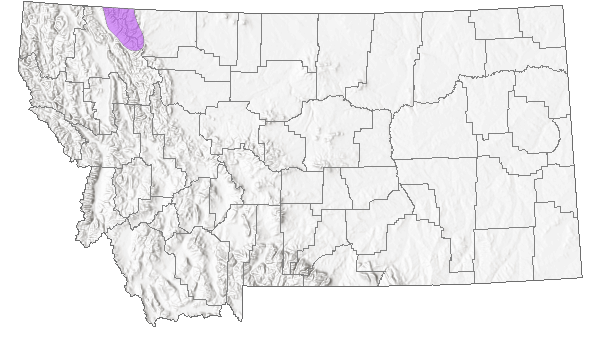
 Native
Range Comments
Circumpolar south to BC and Glacier County in MT (Lesica et al. 2012. Manual of Montana Vascular Plants. BRIT Press. Fort Worth, TX).
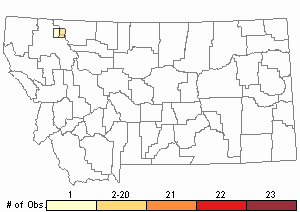
Observations in Montana Natural Heritage Program Database
Number of Observations: 22
(Click on the following maps and charts to see full sized version)
Map Help and Descriptions
Relative Density
Recency
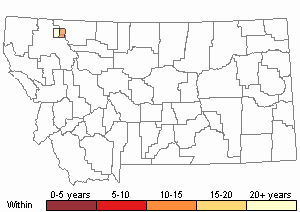
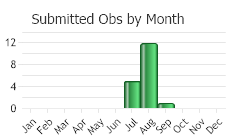
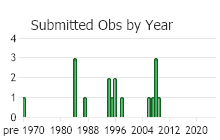
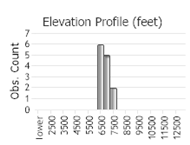 (Observations spanning multiple months or years are excluded from time charts)
Habitat
Moist tundra in the alpine zone.
National Vegetation Classification System Groups Associated with this Species
Alpine
Alpine - Vegetated
Wetland and Riparian
Alpine Riparian and Wetland
Wet Meadow and Marsh
Stewardship Responsibility
Threats or Limiting Factors
STATE THREAT SCORE REASON
Threat impact not assigned because threats are not known (MTNHP Threat Assessment 2021).
References
- Literature Cited AboveLegend:
 View Online Publication
- Lesica, P., M.T. Lavin, and P.F. Stickney. 2012. Manual of Montana Vascular Plants. Fort Worth, TX: BRIT Press. viii + 771 p.
 MTNHP Threat Assessment. 2021. State Threat Score Assignment and Assessment of Reported Threats from 2006 to 2021 for State-listed Vascular Plants. Botany Program, Montana Natural Heritage Program, Helena, Montana.
- Additional ReferencesLegend: View Online Publication
Do you know of a citation we're missing?- Bradshaw, M. E. 1981. Monitoring grassland plants in Upper Teesdale, England. Pp 241-251 in: The biological aspects of rare plant conservation. H. Synge, (ed.) John Wiley & Sons Ltd.
- Lesica, P. and B. McCune. 1992. Monitoring the effects of global warming using peripheral rare plants in wet alpine tundra in Glacier National Park, Montana. Unpublished report to Glacier National Park, Research Division, West Glacier, Montana 59936. 55pp.
- Lesica, P., M.T. Lavin, and P.F. Stickney. 2022. Manual of Montana Vascular Plants, Second Edition. Fort Worth, TX: BRIT Press. viii + 779 p.
- Web Search Engines for Articles on "Small Tofieldia"