View in other NatureServe Network Field Guides
NatureServe
Montana
Utah
Wyoming
Idaho
Wisconsin
British Columbia
South Carolina
Yukon
California
New York
Stalked-pod Locoweed - Oxytropis podocarpa
State Rank Reason (see State Rank above)
DRAFT: Requesting feedback on the 2026 revised rank, factors, and State Rank Reason outlined below and in the Conservation Status Rank Report.
Oxytropis podocarpa is rare in Montana, where it is known from only a few occurrences in the mountains along the Rocky Mountain Front north to Glacier National Park. Its habitat is intact and remote with some in designated wilderness. Population levels appear to be at least several thousand plants and maybe over 10,000 plants. Data to determine trends are lacking. However, populations have likely been relatively stable due to the remote and intact nature of the habitat. No significant or probable threats are known beyond those posed by climate change. Surveys are needed to document the population size and extent of several occurrences. Additional surveys of areas of potentially suitable habitat would appear to have a high likelihood of documenting additional populations.
General Description
Stalked-pod Crazyweed is a perennial that usually forms small, dense cushions. Its naked stems are erect or prostrate and up to 7 cm long. The basal leaves are 2-5 cm long and pinnately divided into 9-27 narrowly lance-shaped leaflets. The herbage is covered with stiff, silvery hairs. The 1-2 purple flowers resemble pea flowers and are held erect at the top of the stem. The corolla is 12-17 mm long, and the tubular calyx is purplish and 2/3 the length of the corolla. The papery, inflated pod is 15-25 mm long and ovoid in outline.
Phenology
Flowering in June, fruiting late June-August.
Diagnostic Characteristics
This is our only purple-flowered Oxytropis with fewer than 4 flowers. Species of alpine Astragalus have leafy stems.
Species Range
Montana Range
Range Descriptions
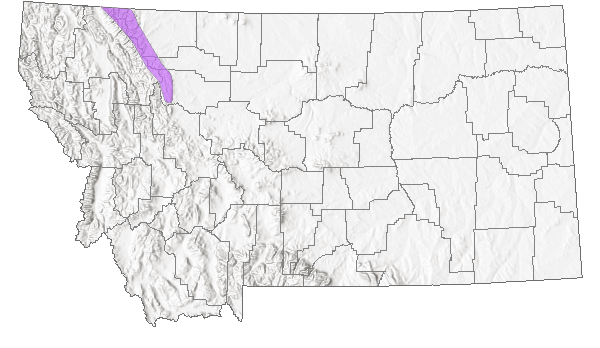
 Native
Range Comments
AB to CO; Baffin Island to NL (Lesica et al. 2012. Manual of Montana Vascular Plants. BRIT Press. Fort Worth, TX).
Observations in Montana Natural Heritage Program Database
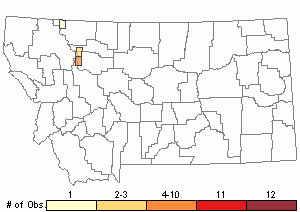
Number of Observations: 14
(Click on the following maps and charts to see full sized version)
Map Help and Descriptions
Relative Density
Recency
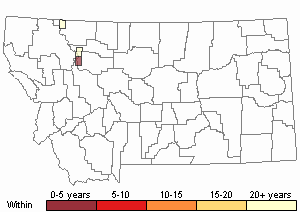
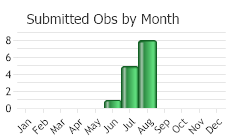
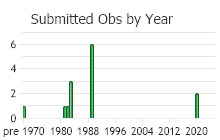
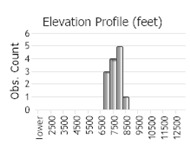 (Observations spanning multiple months or years are excluded from time charts)
Habitat
Gravelly ridges and slopes, often on limestone, in the alpine zone.
National Vegetation Classification System Groups Associated with this Species
Alpine
Alpine - Sparse and Barren
Alpine - Vegetated
Wetland and Riparian
Alpine Riparian and Wetland
Ecology
POLLINATORS The following animal species have been reported as pollinators of this plant species or its genus where their geographic ranges overlap:
Bombus appositus,
Bombus bifarius,
Bombus centralis,
Bombus fervidus,
Bombus flavifrons,
Bombus melanopygus,
Bombus nevadensis,
Bombus rufocinctus,
Bombus sylvicola,
Bombus occidentalis,
Bombus insularis, and
Bombus kirbiellus (Macior 1974, Bauer 1983, Shaw and Taylor 1986, Williams et al. 2014, Miller-Struttmann and Galen 2014).
Stewardship Responsibility
Threats or Limiting Factors
STATE THREAT SCORE REASON
Threat impact not assigned because threats are not known (MTNHP Threat Assessment 2021).
References
- Literature Cited AboveLegend:
 View Online Publication
- Bauer, P.J. 1983. Bumblebee pollination relationships on the Beartooth Plateau tundra of Southern Montana. American Journal of Botany. 70(1): 134-144.
- Lesica, P., M.T. Lavin, and P.F. Stickney. 2012. Manual of Montana Vascular Plants. Fort Worth, TX: BRIT Press. viii + 771 p.
 Macior, L.M. 1974. Pollination ecology of the Front Range of the Colorado Rocky Mountains. Melanderia 15: 1-59.
- Miller-Struttmann, N.E. and C. Galen. 2014. High-altitude multi-taskers: bumble bee food plant use broadens along an altitudinal productivity gradient. Oecologia 176:1033-1045.
- MTNHP Threat Assessment. 2021. State Threat Score Assignment and Assessment of Reported Threats from 2006 to 2021 for State-listed Vascular Plants. Botany Program, Montana Natural Heritage Program, Helena, Montana.
- Shaw, D.C. and R.J. Taylor.1986. Pollination ecology of an alpine fell-field community in the North Cascades. Northwest Science 60:21-31.
- Williams, P., R. Thorp, L. Richardson, and S. Colla. 2014. Bumble Bees of North America. Princeton, NJ: Princeton University Press. 208 p.
- Additional ReferencesLegend: View Online Publication
Do you know of a citation we're missing?- Lesica, P., M.T. Lavin, and P.F. Stickney. 2022. Manual of Montana Vascular Plants, Second Edition. Fort Worth, TX: BRIT Press. viii + 779 p.
- Web Search Engines for Articles on "Stalked-pod Locoweed"