View in other NatureServe Network Field Guides
NatureServe
Montana
Utah
Wyoming
Idaho
Wisconsin
British Columbia
South Carolina
Yukon
California
New York
Lackschewitz' Milkvetch - Astragalus lackschewitzii
Other Names:
Astragalus molybdenus var. lackschewitzii
State Rank Reason (see State Rank above)
DRAFT: Requesting feedback on the 2026 revised rank, factors, and State Rank Reason outlined below and in the Conservation Status Rank Report.
Astragalus lackschewitzii is a Montana endemic restricted to rocky, alpine slopes of the Rocky Mountain Front. The species' habitat is remote and not generally subject to human disturbance. Its limited distribution and relatively small populations make the species vulnerable over the long-term.
Surveys of potentially suitable habitat in the vicinity of the known populations may locate additional occurrences. Monitoring of a subset of populations is needed to be able to determine potential population trends.
General Description
Lackschewitz' Milkvetch is a low and loosely tufted or matted perennial, with prostrate or ascending stems less than 10 cm long, arising from a branched rootcrown. Leaves are alternate on the stem, 2.2-5.8 cm long, with 15-23 ovate or elliptic leaflets; the upper leaflet surface is glabrous and the lower surface and outer margins have short hairs. The 3-5 pea-like flowers are borne in an open, upright inflorescence that often becomes prostrate as fruits mature. Petals are 8.5-11.2 mm long and purplish-blue. The calyx is 2.5-3.8 mm long and covered with uniformly short, straight black hairs sometimes intermixed with white. The oval or elliptic pod is 9-11.2 mm long, curved upward, and triangular in cross section, with a groove at the bottom, and covered with short hairs.
Phenology
Flowering and fruiting in July-August.
Diagnostic Characteristics
The other two Astraglus species that are small, low-growing species on limestone at high elevations in nothwest Montana are A. alpinus and A. bourgovii. The former differs from A. lackschewitzii in having leaflets that are blunt at the tip and pods that are almost completely divided into two chambers. The latter differs in that it has pods which are oval in cross-section.
Species Range
Montana Range
Range Descriptions
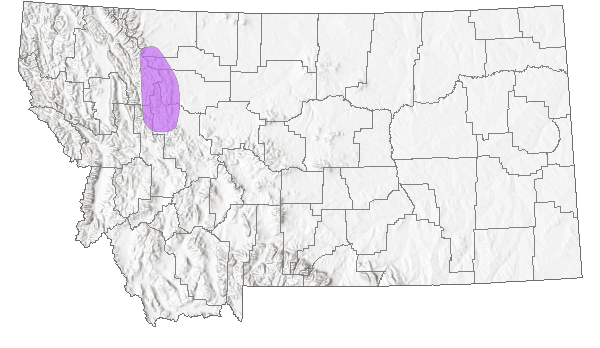
 Native
Range Comments
Montana endemic, restricted to the Rocky Mountain front range in west-central Montana, Teton County (Lavin and Marriott 1997).
Observations in Montana Natural Heritage Program Database
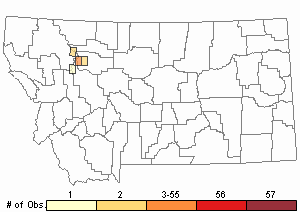
Number of Observations: 59
(Click on the following maps and charts to see full sized version)
Map Help and Descriptions
Relative Density
Recency
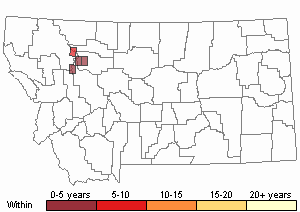
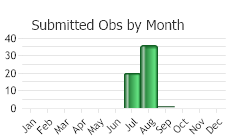
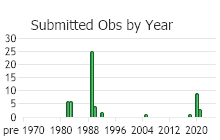
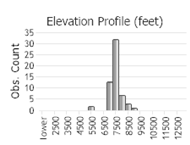 (Observations spanning multiple months or years are excluded from time charts)
Habitat
Open, gravelly, calcareous soil and talus on ridge tops and slopes in alpine or subalpine zones.
National Vegetation Classification System Groups Associated with this Species
Alpine
Alpine - Sparse and Barren
Alpine - Vegetated
Wetland and Riparian
Alpine Riparian and Wetland
Ecology
POLLINATORS The following animal species have been reported as pollinators of this plant species or its genus where their geographic ranges overlap:
Bombus vagans,
Bombus appositus,
Bombus auricomus,
Bombus bifarius,
Bombus borealis,
Bombus centralis,
Bombus fervidus,
Bombus flavifrons,
Bombus huntii,
Bombus mixtus,
Bombus nevadensis,
Bombus rufocinctus,
Bombus ternarius,
Bombus terricola,
Bombus occidentalis,
Bombus pensylvanicus,
Bombus griseocollis, and
Bombus insularis (Macior 1974, Thorp et al. 1983, Mayer et al. 2000, Colla and Dumesh 2010, Wilson et al. 2010, Koch et al. 2012, Miller-Struttmann and Galen 2014, Williams et al. 2014).
Stewardship Responsibility
Threats or Limiting Factors
STATE THREAT SCORE REASON
Reported threats to Montana’s populations of Lackschewitz' Milkvetch are currently assigned as unknown (MTNHP Threat Assessment 2021). A small portion of the population occurs along hiking trails, but impacts due to recreation activities are insignificant.
References
- Literature Cited AboveLegend:
 View Online Publication
 Colla, S.R. and S. Dumesh. 2010. The bumble bees of southern Ontario: notes on natural history and distribution. Journal of the Entomological Society of Ontario 141:39-68.
- Koch, J., J. Strange, and P. Williams. 2012. Bumble bees of the western United States. Washington, DC: USDA Forest Service, Pollinator Partnership. 143 p.
- Macior, L.M. 1974. Pollination ecology of the Front Range of the Colorado Rocky Mountains. Melanderia 15: 1-59.
- Mayer, D.F., E.R. Miliczky, B.F. Finnigan, and C.A. Johnson. 2000. The bee fauna (Hymenoptera: Apoidea) of southeastern Washington. Journal of the Entomological Society of British Columbia 97: 25-31.
- Miller-Struttmann, N.E. and C. Galen. 2014. High-altitude multi-taskers: bumble bee food plant use broadens along an altitudinal productivity gradient. Oecologia 176:1033-1045.
- MTNHP Threat Assessment. 2021. State Threat Score Assignment and Assessment of Reported Threats from 2006 to 2021 for State-listed Vascular Plants. Botany Program, Montana Natural Heritage Program, Helena, Montana.
- Thorp, R.W., D.S. Horning, and L.L. Dunning. 1983. Bumble bees and cuckoo bumble bees of California (Hymenoptera: Apidae). Bulletin of the California Insect Survey 23:1-79.
- Williams, P., R. Thorp, L. Richardson, and S. Colla. 2014. Bumble Bees of North America. Princeton, NJ: Princeton University Press. 208 p.
- Wilson, J.S., L.E. Wilson, L.D. Loftis, and T. Griswold. 2010. The montane bee fauna of north central Washington, USA, with floral associations. Western North American Naturalist 70(2): 198-207.
- Additional ReferencesLegend: View Online Publication
Do you know of a citation we're missing?- Lavin, M. and H. Marriott. 1997. Astragalus molybdenus s.l. (Leguminosae): Higher taxonomic relationships and identity of constituent species. Systematic Botany 22(2):199-217.
- Lavin, M., S. Mathews, C. Hughes, H. Marriott and S. Shelly. 1990. Intraspecific chloroplast DNA diversity is high in some wild species of Leguminosae. Amer. J. Bot. 77 (supplement):144 (abstract).
- Lesica, P., M.T. Lavin, and P.F. Stickney. 2012. Manual of Montana Vascular Plants. Fort Worth, TX: BRIT Press. viii + 771 p.
- Lesica, P., M.T. Lavin, and P.F. Stickney. 2022. Manual of Montana Vascular Plants, Second Edition. Fort Worth, TX: BRIT Press. viii + 779 p.
- Schassberger, L.A. And J.S. Shelly. 1990. Status Review and Taxonomic Studies of Astragalus molybdenus, Lewis & Clark National Forest. Unpublished Report. Montana Natural Heritage Program, Helena, MT 45 pp.
- Web Search Engines for Articles on "Lackschewitz' Milkvetch"