View in other NatureServe Network Field Guides
NatureServe
Montana
Utah
Wyoming
Idaho
Wisconsin
British Columbia
South Carolina
Yukon
California
New York
Small-flowered Pennycress - Noccaea parviflora
Other Names:
Thlaspi parviflorum
State Rank Reason (see State Rank above)
DRAFT: Requesting feedback on the 2026 revised rank, factors, and State Rank Reason outlined below and in the Conservation Status Rank Report.
Noccaea parviflora is a regional endemic of Idaho, Montana and Wyoming. In Montana, it occurs in the southwest portion of the state at over 24 occurrences. Population levels are imprecisely known though they appear likely to number many thousands. Populations may fluctuate from year to year as the plant is a short-lived perennial. Trends are largely unknown though have likely been relatively stable in the recent past. No significant and imminent threats have been documented. However, climate change and livestock grazing may negatively impact one or more occurrences, though the magnitude and immediacy of any impacts is uncertain. The species' rarity, in conjunction with uncertainty surrounding potential threats and possible declines in populations over the long-term lead to uncertainty in the species rank though the species appears that it may still be vulnerable. Collection of more comprehensive data may show that the species is relatively secure.
Surveys of the known occu
General Description
Noccaea parviflora is a taprooted biennial or short-lived perennial that reaches 1-3 dm in height and is often branched above the middle of the stem. The foliage is glabrous and glaucous, and basal leaves are 5-15 mm long with a slender stalk and narrowly elliptic blades that are sometimes toothed. Stems leaves are sessile and clasp the stem. Flowers are borne on short, nearly horizontal stalks in a narrow inflorescence that elongates as the fruits mature. The four white petals are 2-3 mm long, and the four green sepals 1-1.5 mm long. The oblanceolate, flattened fruits are 5-7 mm long, with a style up of to 0.5 mm.
Phenology
Plants flower in late June and early July, and fruit matures in August.
Diagnostic Characteristics
Noccaea parviflora is similar to the more common N. fendleri. However, the latter has longer sepals and petals, and the style in fruit is at least 1 mm long.
Species Range
Montana Range
Range Descriptions
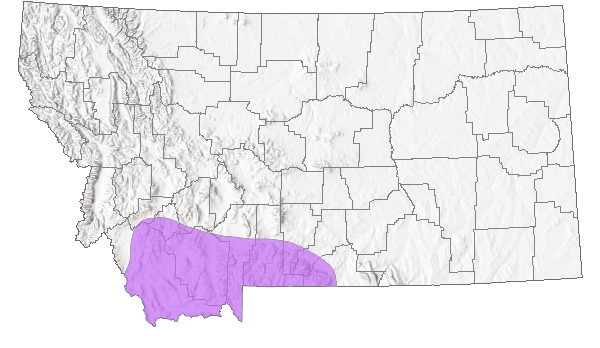
 Native
Range Comments
Central Idaho, northwestern Wyoming (Absarokas, Wind Rivers, and southwestern Bighorns, greater Yellowstone area), and Montana. Regional endemic (MTNHP 1999; Walt Fertig, personal communication 1999).
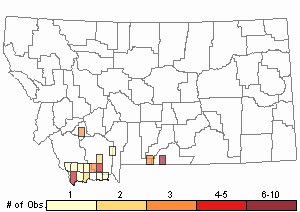
Observations in Montana Natural Heritage Program Database
Number of Observations: 43
(Click on the following maps and charts to see full sized version)
Map Help and Descriptions
Relative Density
Recency
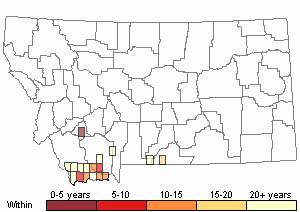
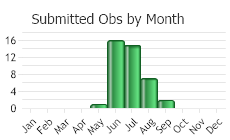
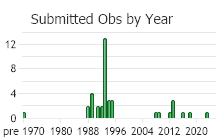
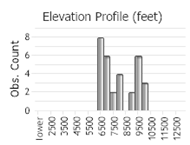 (Observations spanning multiple months or years are excluded from time charts)
Habitat
Noccaea parviflora is found in north-central Wyoming, east-central Idaho and southwest Montana. In Montana it is known from Beaverhead, Carbon, Madison, Park and Silver Bow counties, where it is found from mid-elevation grasslands to alpine turf (6,500 to 10,000 feet). It most often inhabits sagebrush steppe dominated by Artemisia tridentata ssp. vaseyana and Festuca idahoensis. Several moisture-loving species, such as Juncus balticus and Potentilla fruticosa, are often also present in these habitats. Noccaea parviflora has also been found occasionally in alpine turf communities, ranging from moist habitats dominated by Deschampsia cespitosa and Carex scirpoidea to drier sites supporting Carex elynoides.
National Vegetation Classification System Groups Associated with this Species
Alpine
Alpine - Vegetated
Shrubland
Sagebrush Shrubland
Grassland
Montane - Subalpine Grassland
Wetland and Riparian
Alpine Riparian and Wetland
Wet Meadow and Marsh
Ecology
Noccaea parviflora is a short-lived plant, smaller than the dominant species in most habitats where it occurs. It flowers early and is often found in open microsites between shrubs or bunchgrasses. Given its growth form and habitat, it may be expected to respond positively to disturbances such as moderate grazing or fire that opens the canopy.
Management
Fire and grazing are two important forces affecting small-flowered pennycress habitat. Disturbance from fire reduces competition from sagebrush and large bunchgrasses and likely enhances population viability for Noccaea parviflora. Livestock grazing generally favors broad-leaved forbs at the expense of graminoids. Noccaea parviflora is a very small plant likely to benefit from removal of the dominant grass canopy. Nearly all known Montana populations of N. parviflora are on public land, primarily managed by the U.S. Forest Service. Most of these sites are subject to livestock grazing.
Stewardship Responsibility
References
- Additional ReferencesLegend:
 View Online Publication
Do you know of a citation we're missing? Aho, Ken Andrew. 2006. Alpine and Cliff Ecosystems in the North-Central Rocky Mountains. Ph.D. Dissertation. Bozeman, Montana: Montana State University. 343 p.
- Culver, D.R. 1994. Floristic analysis of the Centennial Region, Montana. M.Sc. Thesis. Montana State University, Bozeman. 199 pp.
- Lesica, P. 1992. Vascular plant and sensitive plant species inventory for the Highland Mountains, Deerlodge National Forest. Unpublished report prepared for the Deerlodge National Forest. Montana Natural Heritage Program, Helena, MT. 21 pp. plus appendices, photographs.
- Lesica, P. 1993. Vegetation and flora of the Line Creek Plateau area, Carbon County, Montana. Unpublished report to USDA Forest Service, Intermountain Research Station. Montana Natural Heritage Program, Helena, Montana. 30 pp.
- Lesica, P. and J. Vanderhorst. 1995. Sensitive plant survey of the Sage Creek area, Beaverhead County, Montana, Dillon Resource Area, Bureau of Land Management. Unpublished report to the Bureau of Land Management. Montana Natural Heritage Program. 36 pp. plus appendices.
- Lesica, P., M.T. Lavin, and P.F. Stickney. 2012. Manual of Montana Vascular Plants. Fort Worth, TX: BRIT Press. viii + 771 p.
- Lesica, P., M.T. Lavin, and P.F. Stickney. 2022. Manual of Montana Vascular Plants, Second Edition. Fort Worth, TX: BRIT Press. viii + 779 p.
- Rollins, R. C. 1993. The Cruciferae of Continental North America: systematics of the mustard family from the Arctic to Panama. Stanford University Press, Stanford, California. 976 pp.
- Vanderhorst, J.P. and P. Lesica. 1995a. Sensitive plant survey of the Tendoy Mountains in the Beaverhead National Forest, Beaverhead County, Montana. Unpublished report to the Bureau of Land Management, Butte District. Montana Natural Heritage Program, Helena, MT. 59 pp. plus appendices.
- Web Search Engines for Articles on "Small-flowered Pennycress"