View in other NatureServe Network Field Guides
NatureServe
Montana
Utah
Wyoming
Idaho
Wisconsin
British Columbia
South Carolina
Yukon
California
New York
Thick-leaf Whitlow-grass - Draba crassa
State Rank Reason (see State Rank above)
DRAFT: Requesting feedback on the 2026 revised rank, factors, and State Rank Reason outlined below and in the Conservation Status Rank Report.
Draba crassa is known in Montana from four mountain ranges and at least a dozen sites, where the species is at the northern edge of its range. Population sizes are unknown as are trends. However, populations are likely relatively stable or have experienced only minor declines as the species' alpine habitat is remote and largely intact. Threats to the species are generally unknown, though shifts in climate may negatively impact the species, and it is rated as "Extremely Vulnerable" to climate change as part of an analysis using the CCVI.
Surveys are needed to document population sizes and extent of the known occurrences. Monitoring of a subset of populations is needed to be able to determine potential population trends.
General Description
Perennial from a simple or branched caudex clothed in old leaf bases. Stems simple, 4–12 cm. Basal leaves petiolate, oblanceolate, 2–5 cm long, entire. Stem leaves several, lanceolate, sessile. Vestiture of simple and forked hairs on the stem and sparse cilia on leaf margins. Petals yellow, 3–5 mm long. Fruit ascending, 5–9 × 3–5 mm, glabrous, often twisted; style 0.3–1 mm long; lower pedicels 2–8 mm long (
Lesica et al. 2012. Manual of Montana Vascular Plants. BRIT Press. Fort Worth, TX).
Species Range
Montana Range
Range Descriptions
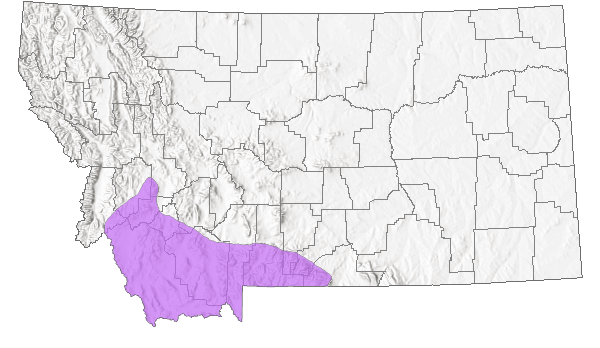
 Native
Range Comments
Regional endemic of south-central Montana, western Wyoming, northeastern Utah, and Colorado.
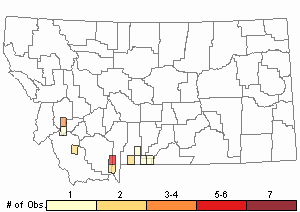
Observations in Montana Natural Heritage Program Database
Number of Observations: 21
(Click on the following maps and charts to see full sized version)
Map Help and Descriptions
Relative Density
Recency
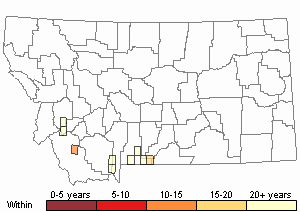
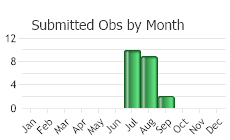
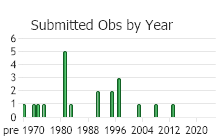
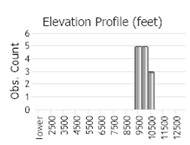 (Observations spanning multiple months or years are excluded from time charts)
Habitat
Rocky areas in the alpine particularly on cool, shady sites.
National Vegetation Classification System Groups Associated with this Species
Alpine
Alpine - Sparse and Barren
Alpine - Vegetated
Wetland and Riparian
Alpine Riparian and Wetland
Stewardship Responsibility
Threats or Limiting Factors
STATE THREAT SCORE REASON
Reported threats to Montana’s populations of Thick-leaf Whitlow-grass include a population expected to decline by at least one-third where invasive weeds have strong negative impacts (MTNHP Threat Assessment 2021).
References
- Literature Cited AboveLegend:
 View Online Publication
- Lesica, P., M.T. Lavin, and P.F. Stickney. 2012. Manual of Montana Vascular Plants. Fort Worth, TX: BRIT Press. viii + 771 p.
 MTNHP Threat Assessment. 2021. State Threat Score Assignment and Assessment of Reported Threats from 2006 to 2021 for State-listed Vascular Plants. Botany Program, Montana Natural Heritage Program, Helena, Montana.
- Additional ReferencesLegend: View Online Publication
Do you know of a citation we're missing?- Aho, Ken Andrew. 2006. Alpine and Cliff Ecosystems in the North-Central Rocky Mountains. Ph.D. Dissertation. Bozeman, Montana: Montana State University. 343 p.
- Lesica, P., M.T. Lavin, and P.F. Stickney. 2022. Manual of Montana Vascular Plants, Second Edition. Fort Worth, TX: BRIT Press. viii + 779 p.
- Rollins, R. C. 1993. The Cruciferae of Continental North America: systematics of the mustard family from the Arctic to Panama. Stanford University Press, Stanford, California. 976 pp.
- Web Search Engines for Articles on "Thick-leaf Whitlow-grass"