View in other NatureServe Network Field Guides
NatureServe
Montana
Utah
Wyoming
Idaho
Wisconsin
British Columbia
South Carolina
Yukon
California
New York
Beartooth Large-flowered Goldenweed - Pyrrocoma carthamoides var. subsquarrosa
Other Names:
Haplopappus carthamoides var. subsquarrosus
State Rank Reason (see State Rank above)
DRAFT: Requesting feedback on the 2026 revised rank, factors, and State Rank Reason outlined below and in the Conservation Status Rank Report.
Pyrrocoma carthamoides var. subsquarrosa is a regional endemic of Montana and Wyoming. Its limited range and small number of populations make it vulnerable to extirpation. Trends are unknown though its habitat is largely intact and in good condition. Significant or potential threats appear to be limited at this time and include potential impacts from grazing and non-native species though neither of these are thought to be a significant issue at the present time.
Some recent surveys have occurred, though additional ones are needed to document the current population sizes and extent in the Pryor Mtns, as well as continued surveys of populations in the Beartooths to monitor their condition and extent.
General Description
We do not yet have descriptive information on this species. Please try the buttons above to search for information from other sources.
Phenology
Flowering occurs in late July - August.
Diagnostic Characteristics
Beartooth large-flowered goldenweed is distinguished from similar composites in south-central Montana by its spiny-margined leaves and involucral bracts, and large heads with inconspicuous yellow rays.
Species Range
Montana Range
Range Descriptions
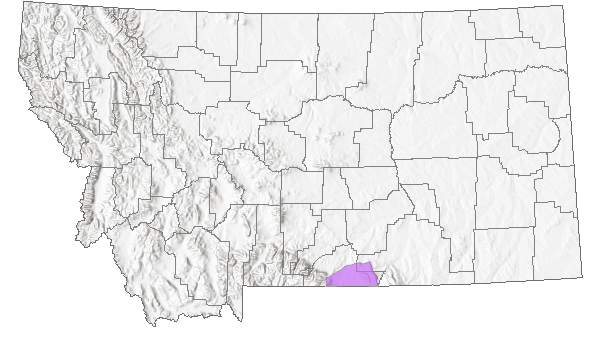
 Native
Range Comments
Regional endemic of southwest Montana and the Absaroka Mountains of northwest Wyoming.
Observations in Montana Natural Heritage Program Database
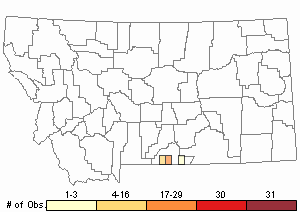
Number of Observations: 200
(Click on the following maps and charts to see full sized version)
Map Help and Descriptions
Relative Density
Recency
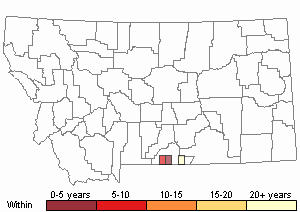
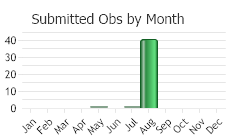
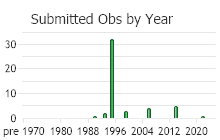
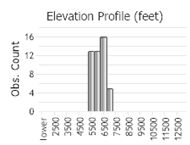 (Observations spanning multiple months or years are excluded from time charts)
Habitat
The Beartooth large-flowered goldenweed typically occurs in grassland and sagebrush habitats dominated by Festuca idahoensis/Agropyron spicatum, Artemisia tridentata/Festuca idahoensis, and Artemisia arbuscula/Agropyron spicatum (Lesica 1995). Shrub cover is typically low (1-5%), compared to that of graminoids (20-50%) and forbs (30-75%); bare ground ranges from 5-30%. Some sites support scattered Pinus flexilis.
This plant is found most frequently and abundantly on moderate to steep slopes (10-50%) with a cool aspect (NW, N, NE, E) (Lesica 1995); on warmer exposures, it tends to be sparser. Soils tend to be moderately deep, sandy, and high in coarse fragments. It occurs largely on soils derived, at least in part, from Madison limestone, though small satellite populations occur on soils derived from granitic materials (in the Rock Creek valley) and volcanics (in Wyoming).
National Vegetation Classification System Groups Associated with this Species
Forest and Woodland
Low Elevation - Xeric Forest and Woodland
Montane - Subalpine Forest and Woodland
Shrubland
Arid - Saline Shrubland
Sagebrush Shrubland
Grassland
Lowland - Prairie Grassland
Ecology
Fire plays an important role in structuring the vegetation in this species' habitat (Lesica 1995). Beartooth large-flowered goldenweed grows in areas with a very low cover of Artemisia tridentata, which dominates much of the adjacent lands. The relationship among Beartooth large-flowered goldenweed, A. tridentata and fire is not known, but it may be that the goldenweed does not tolerate the shade created by dense stands of A. tridentata or Pinus flexilis (Lesica 1995). If that is true, the goldenweed will occur only at sites where A. tridentata and/or P. flexilis will not grow, or where they are burned frequently enough to prevent dominance.
Bumblebees (Family Apidae, Bombus spp.) frequently visit the flowers of this goldenweed, and sulphur butterflies (Family Pieridae, Colias spp.) have also been observed visiting flowers (Lesica 1995). Seed production is probably not limited by pollinators, since this is one of relatively few plants blooming in August, when pollinating insects are common.
The achenes have numerous capillary bristles, and are likely dispersed by wind in late summer and fall when they are shed (Lesica 1995). Deer or elk may also disperse achenes that become attached to fur.
Management
There is evidence that fire is important for maintaining at least a portion of this species' habitat along the Beartooth Front, where it is most abundant in mesic grasslands on cool slopes. These are the habitats most prone to encroachment by Artemisia spp. or Pinus flexilis, however the goldenweed does not occur within dense or even moderate stands of sagebrush or pine. A significant increase in sagebrush and pine due to fire suppression could greatly reduce habitat for this plant in the foothills of the Beartooth Mountains, and burns may be important for maintaining viable populations over the long term.
Many populations are found on lands grazed by cattle, which is probably not detrimental to this species and may even favor it at moderate levels (Lesica 1995). While grazing can increase sagebrush cover, which is likely detrimental to Beartooth large-flowered goldenweed, it may also decrease the vigor and abundance of palatable grasses that compete with this forb, thus allowing it to increase. Therefore, cattle grazing, by itself, is likely to have a positive or nominal effect on Beartooth large-flowered goldenweed's abundance. However, many forbs that are unpalatable to cattle provide fair to good forage for domestic sheep, thus sheep grazing could negatively impact its abundance (Lesica 1995).
The widespread introduction of aggressive exotic plants could pose a pernicious threat to this species. Centaurea maculosa (spotted knapweed) occurs along roads as well as in native grasslands along the Beartooth Front, where semi-arid climate and gravelly soils contribute to its spread (Lesica 1995). Leafy spurge (Euphorbia esula), another aggressive exotic that has been observed in the area, could also pose a serious threat. It will be particularly important to minimize the introduction of aggressive weeds and to control infestations along roads, to prevent their spread into the native grasslands.
Stewardship Responsibility
Threats or Limiting Factors
STATE THREAT SCORE REASON
Threat impact not assigned because threats are not known (MTNHP Threat Assessment 2021).
References
- Literature Cited AboveLegend:
 View Online Publication
- Lesica, P., M.T. Lavin, and P.F. Stickney. 2012. Manual of Montana Vascular Plants. Fort Worth, TX: BRIT Press. viii + 771 p.
 MTNHP Threat Assessment. 2021. State Threat Score Assignment and Assessment of Reported Threats from 2006 to 2021 for State-listed Vascular Plants. Botany Program, Montana Natural Heritage Program, Helena, Montana.
- Additional ReferencesLegend: View Online Publication
Do you know of a citation we're missing?- Lesica, P. 1993. Vegetation and flora of the Line Creek Plateau area, Carbon County, Montana. Unpublished report to USDA Forest Service, Intermountain Research Station. Montana Natural Heritage Program, Helena, Montana. 30 pp.
- Lesica, P. 1995. Conservation status of Haplopappus carthamoides var. Subsquarrosus in Montana. Unpublished report to the U.S. Forest Service and the U.S. Bureau of Land Management. Montana Natural Heritage Program. Helena, Montana. 22 pp. plus appendices.
- Lesica, P., M.T. Lavin, and P.F. Stickney. 2022. Manual of Montana Vascular Plants, Second Edition. Fort Worth, TX: BRIT Press. viii + 779 p.
- Web Search Engines for Articles on "Beartooth Large-flowered Goldenweed"