View in other NatureServe Network Field Guides
NatureServe
Montana
Utah
Wyoming
Idaho
Wisconsin
British Columbia
South Carolina
Yukon
California
New York
Red-tailed Chipmunk - Neotamias ruficaudus
Other Names:
Tamias ruficaudus
Native Species
Global Rank:
G4G5
State Rank:
S4
(see State Rank Reason below)
Agency Status
USFWS:
USFS:
BLM:
FWP SWAP:
SGCN
State Rank Reason (see State Rank above)
Species is common with closed canopy and mesic forest. Loss of denser mesic forest is the primary threat to this species.
General Description
We do not yet have descriptive information on this species. Please try the buttons above to search for information from other sources.
Species Range
Montana Range
Range Descriptions
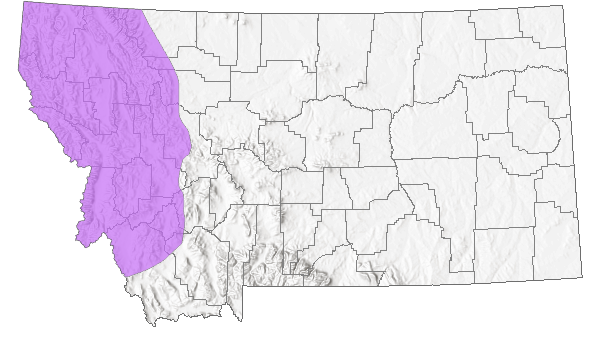
 Native
Western Hemisphere Range
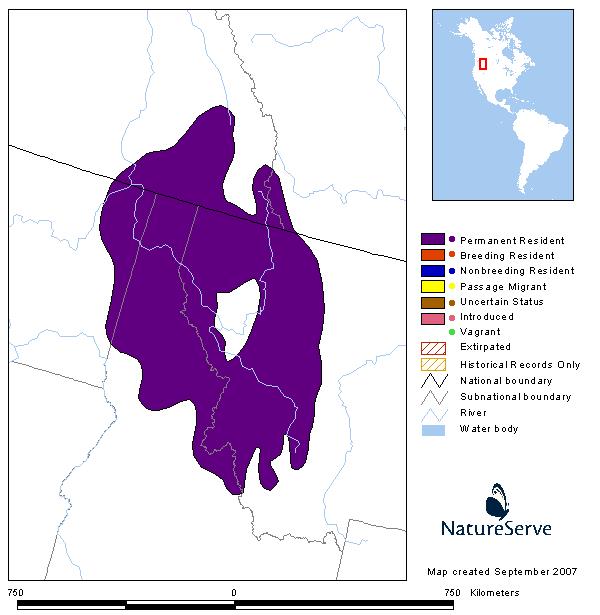
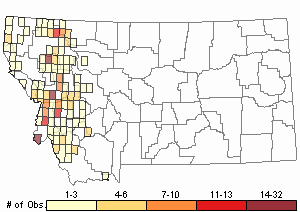
Observations in Montana Natural Heritage Program Database
Number of Observations: 360
(Click on the following maps and charts to see full sized version)
Map Help and Descriptions
Relative Density
Recency
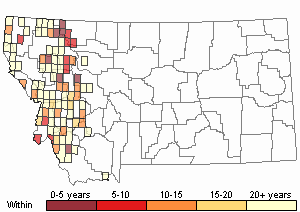
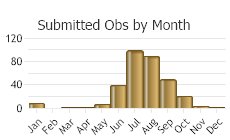
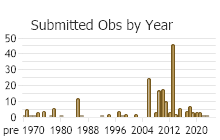
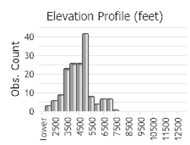 (Observations spanning multiple months or years are excluded from time charts)
Migration
Non-migratory.
Habitat
Moist forest. Douglas-fir and subalpine fir. Most abundant in edge openings. Sometimes ranges into alpine except in Glacier National Park area where T. minimus occupies alpine habitats (Hoffmann and Pattie 1968, Beg 1969). Will occupy higher elevations with T. amoenus.
National Vegetation Classification System Groups Associated with this Species
Alpine
Alpine - Sparse and Barren
Alpine - Vegetated
Forest and Woodland
Deciduous Forest and Woodland
Low Elevation - Xeric Forest and Woodland
Montane - Subalpine Forest and Woodland
Shrubland
Foothills - Montane Shrubland
Sagebrush Shrubland
Grassland
Lowland - Prairie Grassland
Montane - Subalpine Grassland
Wetland and Riparian
Alpine Riparian and Wetland
Riparian and Wetland Forest
Riparian Shrubland
Wet Meadow and Marsh
Recently Disturbed or Modified
Harvested Forest
Insect-Killed Forest
Recently Burned
Human Land Use
Agriculture
Developed
Food Habits
Primarily seeds and fruits. Leaves and flowers in spring, less so in summer. Occasionally uses arthropods. Seasonal shifts in foraging sites and consumption related to availability (Beg 1969). Hoards food.
Ecology
Contiguous allopatry with other chipmunks, though some overlap occurs. Specific habitats vary. May to October average monthly maximum distance moved: 384 ft for adult males, 246 ft. for breeding adult females, 290 ft. for non-breeding adult females, 232 ft. for juveniles (Beg 1969).
Reproductive Characteristics
11.1 to 15.0% yearlings pregnant, 50 to 73% adult females pregnant each year. One litter/year, average 4.85 young/litter. Breed late April to May. Most young born in June. Lactation until mid- to late July.
Stewardship Responsibility
References
- Literature Cited AboveLegend:
 View Online Publication
- Beg, M.A. 1969. Habitats, food habits, and population dynamics of the red-tailed chipmunk (Eutamias ruficaudus) in Western Montana. PhD. Dissertation University of Montana, Missoula. 153 pp.
 Hoffmann, R.S. and D.L. Pattie. 1968. A guide to Montana mammals: identification, habitat, distribution, and abundance. Missoula, MT: University of Montana. 133 p.
- Additional ReferencesLegend: View Online Publication
Do you know of a citation we're missing?- [WWPC] Washington Water Power Company. 1995. 1994 wildlife report Noxon Rapids and Cabinet Gorge Reservoirs. Washington Water Power Company. Spokane, WA.
- Adelman, E.B. 1979. A survey of the nongame mammals in the Upper Rattlesnake Creek drainage of western Montana. M.S. thesis. University of Montana, Missoula. 129 pp.
- Beg, M.A. and R.S. Hoffmann. 1977. Age determination and variation in the red-tailed chipmunk, Eutamias ruficaudus. The Murrelet 58:26-36.
- Best, T. L. 1993. Tamias ruficaudus. Mamm. Species 452:1-7.
- Connolly-Newman, Hayley R. 2013. Effect of cover on small mammal abundance and movement through wildlife underpasses. M.S. Thesis. University of Montana. Missoula, MT.
- Conrey, Reesa Yale, 2002, Do highways influence population connectivity in small mammals? M.S. Thesis. University of Montana. Missoula, MT.
- Foresman, K.R. 2001. The wild mammals of Montana. American Society of Mammalogists, Special Publication Number 12. Lawrence, KS. 278 pp.
- Foresman, K.R. 2012. Mammals of Montana. Second edition. Mountain Press Publishing, Missoula, Montana. 429 pp.
- Halvoison, C. H. 1982. Rodent occurrence, habitat disturbance and seed fall in a larch-fir forest. Ecology 63(2):423-433.
- Hanauska-Brown, L., B.A. Maxell, A. Petersen, and S. Story. 2014. Diversity Monitoring in Montana 2008-2010 Final Report. Montana Fish, Wildlife & Parks. Helena, MT. 78 pp.
- Hoffmann, R.S., P.L. Wright, and F.E. Newby. 1969. The distribution of some mammals in Montana. I. Mammals other than bats. Journal of Mammalogy 50(3): 579-604.
- Johnson, L.J. 1960. Mammal studies on the Lubrecht Forest, Montana: a preliminary report. Proc. Mont. Acad. Sci. 20: 40-47.
- Joslin, Gayle, and Heidi B. Youmans. 1999. Effects of recreation on Rocky Mountain wildlife: a review for Montana. [Montana]: Montana Chapter of the Wildlife Society.
- Joslin, Gayle. 1980. Wildlife inventory and hard rock mining impact analysis of the West Cabinet Mountains and Lake Creek Valley, Lincoln County, Montana. MTFWP 91 pgs + 47 pgs app.
- Lockner, F.R. 1968. An analysis of feeding behavior in the red-tailed chipmunk. Ph.D dissertation. University of Montana, Missoula. 146 pp.
- Patterson, B.D., and L. R. Heaney. 1987. Preliminary analysis of geographic variation in red-tailed chipmunks (Eutamias ruficaudus). Journal of Mammalogy 68:782-791.
- Plopper, C.E. 1968. Insular and mainland populations of Peromyscus maniculatus at Flathead Lake, Montana. M.S. thesis. University of Montana, Missoula. 91 pp.
- Reichel, J.D. 1986. Habitat use by alpine mammals in the Pacific Northwest. Arctic and Alpine Research. 18(1): 111-119.
- Reid, F. 2006. Peterson Field Guide to Mammals of North America, 4th Edition. Houghton Mifflin Company: Boston and New York, 608 pp.
- Russell, R. J. and S. Anderson. 1956. Small mammals from Silver Bow County, Montana. Murrelet 37:2-3.
- Rust, H. J. 1946. Mammals of northern Idaho. J. Mammal. 27(4): 308-327.
- Shepherd, Jay F. 1994. Initial response of small mammals to new forestry and overstory removal timber harvests. M.S. Thesis. University of Montana. Missoula, MT.
- Thompson, Richard W., Western Resource Dev. Corp., Boulder, CO., 1996, Wildlife baseline report for the Montana [Montanore] Project, Lincoln and Sanders counties, Montana. In Application for a Hard Rock Operating Permit and Proposed Plan of Operation, Montanore Project, Lincoln and Sanders Counties, Montana. Vol. 5. Stroiazzo, John. Noranda Minerals Corp., Libby, MT. Revised September 1996.
- Tisch, E.L. 1961. Seasonal food habits of the black bear in the Whitefish Range of northwestern Montana. M.S. Thesis. University of Montana, Missoula. 108 pp.
- Web Search Engines for Articles on "Red-tailed Chipmunk"
- Additional Sources of Information Related to "Mammals"